Panelboard vs. Load Center vs. Switchgear: What Electricians Need to Know
A load center is a type of panelboard. Learn how these assemblies differ from switchgear, where switchboards fit, and which ratings matter on the job.
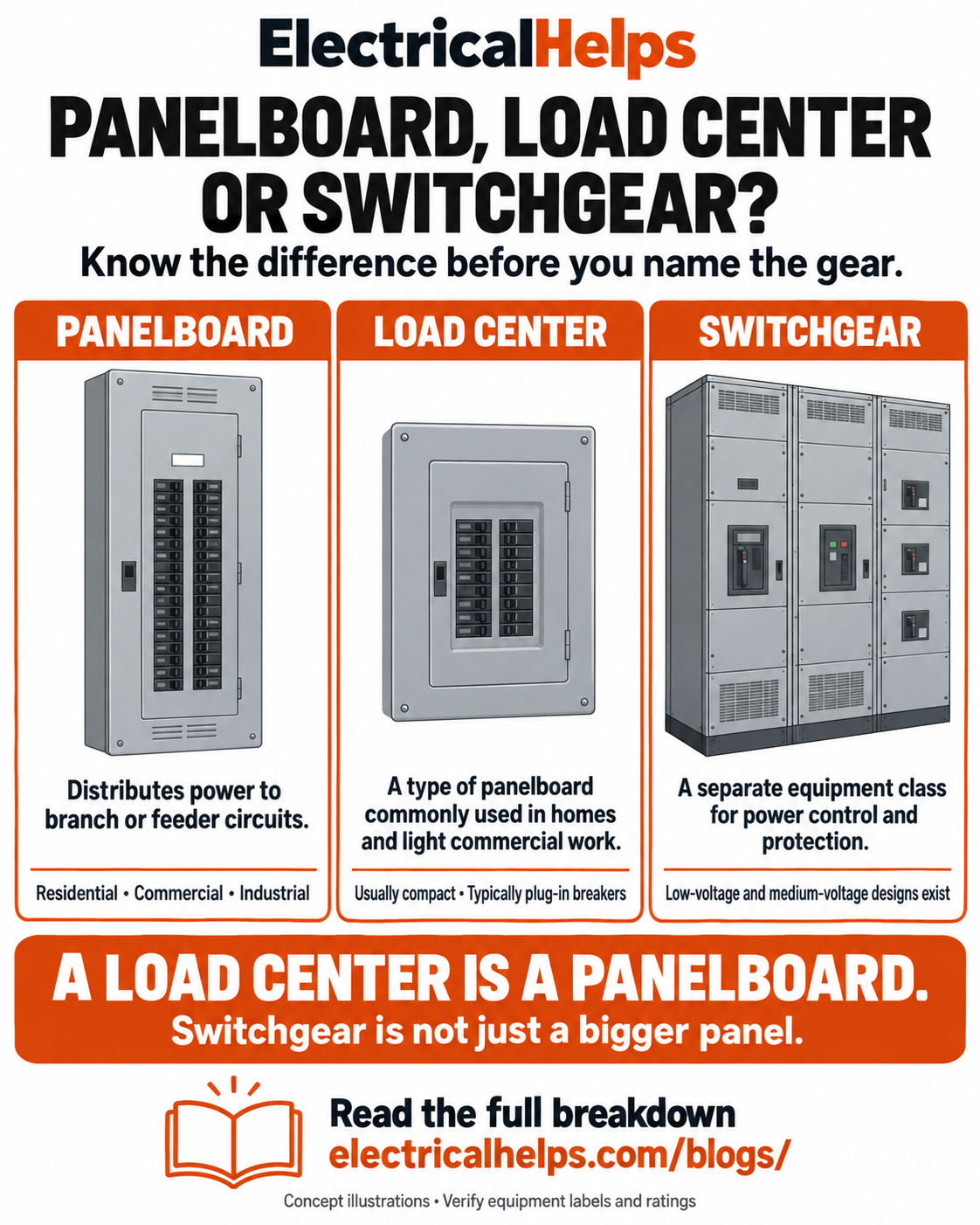
Start here: a load center is a type of panelboard
On a jobsite, “panel,” “breaker box,” and “gear” can describe very different equipment. Those shortcuts are convenient until someone orders a replacement, reviews a submittal, or reads a one-line diagram. The useful distinction is the equipment category and its ratings—not simply how large the enclosure looks.
In U.S. practice, load center is the industry name commonly used for compact, economical panelboards intended mainly for residential and light commercial applications. It is not a completely separate category from panelboards. Eaton’s panelboard fundamentals explain this relationship; Schneider Electric also confirms that its U.S. QO and Homeline load centers are evaluated to UL 67, the panelboard standard. [1, 2]
This article uses U.S. terminology. The switchgear comparison focuses on low-voltage power circuit breaker switchgear; medium-voltage switchgear also exists and has different construction and applicable standards. [3]
What is an electrical panelboard?
A panelboard distributes an incoming supply among outgoing circuits and contains their overcurrent protective devices, usually circuit breakers or fused devices. It combines the bus structure and protective devices in an assembly intended for an enclosure. Common examples include lighting panels, receptacle panels, and power panels supplying equipment or downstream panels. [1, 3]
Commercial panelboards often offer more configuration choices than a typical residential load center: different main arrangements, branch-device types, metering, and enclosure options. Depending on the product family, breakers may be plug-in or bolt-on. “Panelboard” does not automatically mean three-phase, and “bolt-on” is not its definition. [1, 4]
What makes a load center different?
A load center performs the same basic distribution and overcurrent-protection job in a package commonly associated with houses, apartments, and smaller installations. Typical residential examples serve 120/240-volt systems and use plug-in branch breakers. Product offerings vary, so those familiar characteristics should not replace a nameplate check. [4]
The practical differences are usually packaging, intended market, available configurations, and cost. A commercial panelboard may offer features a particular load center does not, but there is no universal ampere number that turns one category into another. A 200-amp label alone cannot identify the assembly or establish its suitability. [1, 4]
“Subpanel” describes a downstream role, not a separate product family. A load center or another panelboard can serve that role. Likewise, having a main breaker does not by itself establish that an assembly is suitable for service equipment; check the equipment markings and the installation requirements. [1, 5]
What is switchgear?
Switchgear combines switching, protection, and associated control equipment for a power system. In larger facilities, low-voltage switchgear often forms part of the main distribution system supplying feeders, transformers, and other distribution equipment. It is a distinct assembly class, not merely a panelboard with more breakers. [3]
Metal-enclosed low-voltage power circuit breaker switchgear is associated with UL 1558 and IEEE C37.20.1. Common designs use individually compartmentalized power circuit breakers, often in drawout arrangements, along with bus and control sections. Exact access arrangements and features depend on the design. [6]
A key consideration is short-time withstand capability: the ability to tolerate a specified fault current for a specified duration. This can support a coordinated protection scheme in which a downstream device clears a fault before an upstream device opens. Coordination must be established for the actual system; buying switchgear does not automatically guarantee it. [7]
Compare the equipment without relying on its size
These are common characteristics, not universal limits. Read the assembly label, approved submittal, and manufacturer documentation for the equipment in front of you. [1–7]
| Feature | Load center | Panelboard (broader category) | Low-voltage power circuit breaker switchgear |
|---|---|---|---|
| Relationship | A type of panelboard | Includes load centers | Separate assembly class |
| Typical application | Homes and light commercial | Branch and feeder distribution | Major facility distribution and protection |
| Common construction | Compact enclosure; plug-in breakers | Wall-mounted enclosure; product-specific devices | Floor-standing, compartmentalized lineup |
| Common standard | UL 67 | UL 67 | UL 1558; IEEE C37.20.1 |
| Selection emphasis | Required circuits and listed ratings | Distribution needs and configuration | Fault duty, coordination, control, maintenance |
Where does a switchboard fit?
Switchboard is another term worth keeping straight. U.S. low-voltage switchboards are generally associated with UL 891, while the low-voltage power circuit breaker switchgear discussed here is associated with UL 1558. Switchboards commonly use group-mounted molded-case or insulated-case breakers; other configurations exist. [6]
A large freestanding lineup is not automatically switchgear. Some switchboards offer individually mounted or drawout devices, and front-access switchgear designs are available. Appearance, breaker removal method, and room location are clues—not a substitute for the assembly’s listing and documentation. [6, 8]
What electricians should check on the documents
Start with the approved one-line diagram and equipment schedule, then compare the submittal and nameplate. A useful review separates normal operating current from fault-duty ratings. A 200-amp main rating describes a different condition from a short-circuit rating expressed in thousands of amperes. [5]
UL’s panelboard guide explains why the assembly’s short-circuit current rating and the protective devices used with it matter together. Do not infer breaker compatibility from physical fit or assume a series rating applies to an unverified combination. Follow the marked combinations and applicable instructions. [5]
- System: voltage, phase, frequency, and intended application.
- Normal load: bus rating, main arrangement, and required outgoing circuits.
- Fault duty: available fault current, assembly rating, breaker interrupting ratings, and any documented series combination.
- Installation: enclosure suitability, service-equipment markings where applicable, required access, and manufacturer instructions.
- System performance: required coordination, control functions, and maintenance provisions.
Sources & further reading
[1] Eaton: Panelboard fundamentals ↗
Panelboard functions, load-center terminology, main arrangements, and device options.
[2] Schneider Electric: QO and Homeline load-center standards ↗
Confirms UL 67 evaluation for these U.S. load-center product lines.
[3] Eaton: Basics in low-voltage distribution equipment ↗
Background on distribution equipment and its role in a facility.
[4] ABB: Load Center vs Panelboard ↗
Typical applications and construction. Product-specific ratings should not be read as universal category limits.
[5] UL Solutions: Panelboard Application Guide ↗
Equipment markings, service-equipment suitability, and short-circuit ratings.
[6] Eaton: Switchboard vs. switchgear application considerations ↗
UL 891 and UL 1558 equipment distinctions.
[7] Intertek: Selective coordination and UL 891 vs. UL 1558 ↗
How system performance and fault withstand requirements affect equipment selection.
[8] Eaton: Front-access low-voltage switchgear ↗
An example showing why rear access is not a universal switchgear characteristic.